
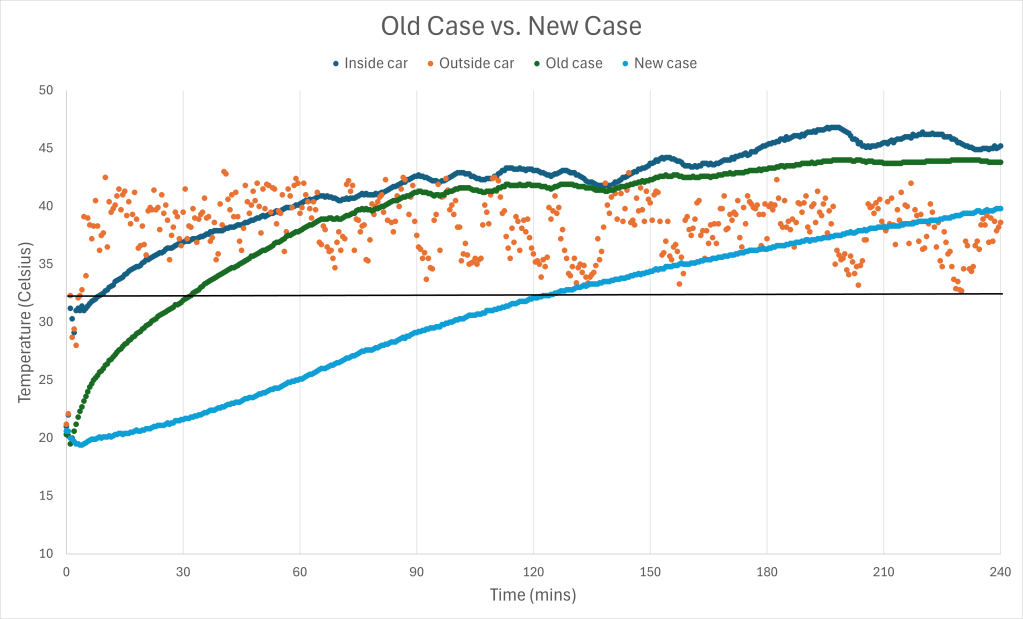
The data above was recorded for a span of 4 hours and shows the results of two instrument cases (the thermally protective case and standard case) when left in a hot car.
Results of Prototype
The upper limit for safe instrument temperature should not exceed 32C (~90F), this was established based on research into safe instrument storage. In the data above, a line is set at 32C to show when the cases exceed this limit. The data shows that the new thermally protective case lasts for 2 hours while the old standard case lasts for only 30 minutes. The outside car temperature although fluctuates, it can be seen that the average temperature outside stays within about 38C(~100F) during the duration of testing. But inside of the car it is shown that the temperature rises logarithmically reaching its high point of 48C (~118F). So while the temperature outside is hot, the temperature within the car is well above the outside temperature.
The thermal protection incorporated in the design proved to be successful in the data shown above. Using a thick layer of insulation helped to thermally protect the interior of the case better than a thin layer of just hard shell. Incorporating a protective sealant not only served as a good thermal barrier but also prevented hot air from entering the case. Additionally, applying a reflective layer of white paint extended the case’s span by reflecting radiation and minimizing heat absorption. The thermally protective case compared to the standard case lasted 4 times times as long, successfully protecting the instrument for 2 hours when exposed to a extreme environment.
 Climate Sound Homepage